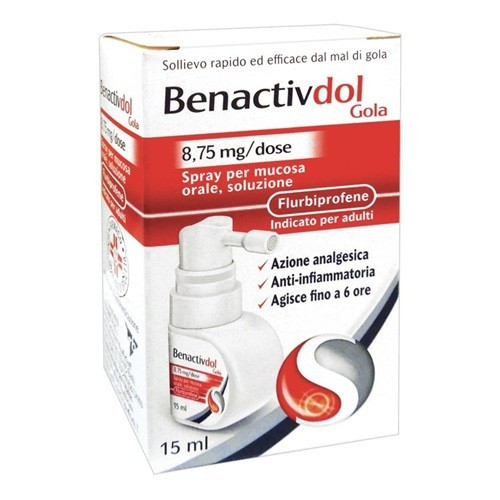
Descrizione Clinica
Oral hygiene Bronchenolo gorge os spray 15ml Bronchenolo
BRONCHENOLO GOLA 2.5 MG/ML
active ingredients
BRONCHENOLO GOLA 2.5 mg/ml Collutory 100 ml of solution contain: • active ingredient: flurbiprofen 250 mg; • excipients with known effects: p-hydroxybenzoate methyl (0,10 g), p-hydroxybenzoate propile (0,02 g), hydrogenated castor oil-40 polyxyethylene (2,00 g). BRONCHENOLO GOLA 2.5 mg/ml oral mucosa spray 100 ml of solution contain: • active ingredient: flurbiprofen 250 mg; • excipients with known effects: p-hydroxybenzoate methyl (0,10 g), p-hydroxybenzoate propile (0,02 g), hydrogenated castor oil-40 polyxyethylene (2,00 g). For the full list of excipients, see paragraph 6.1.Excellent
Glycerol (98%), ethanol, non crystallized liquid sorbitol, hydrogenated castor oil-40 polyxyethylene, sodium saccharin, methyl parahydroxybenzoate, propile parahydroxybenzoate, mint aroma, blue patent V (E131), citric acid anidro, sodium hydroxide, purified water.Therapeutic indications
Symptomatic treatment of irritative-inflammatory states also associated with pain of the oropharyngeal cable (e.g. gums, stomatitis, pharyngitis), also as a result of conservative or extractive dentaria therapy.Contraindications
Do not use the medicine in the following cases: • children under 12 years of age. • hypersensitivity to flurbiprofen or any of the excipients listed in the paragraph 6.1. • patients with known hypersensitivity (e.g. asthma, hives, allergy, rhinitis, angioedema, bronchospasm) towards ibuprofen, acetylsalicylic acid (aspirin) or other nonsteroidal anti-inflammatory drugs (NSAID). • patients with history of gastrointestinal hemorrhage or perforation related to previous treatments with NSAIDs. • patients with active ulcerative colitis or anamnestic, Crohn's disease, recurrent peptic ulcer or gastrointestinal hemorrhage (defined as two or more distinct episodes of proven ulceration or bleeding). • patients with severe heart failure, • severe liver failure and kidney failure (see paragraph 4.4) • Third trimester of pregnancy.Population
Undesirable effects can be minimized with the use of the lowest effective dose for the shortest possible duration of treatment needed to control symptoms (see paragraph 4.4). Population. . Collutory. Adults: the recommended dose is two or three rinses or gargles per day with 10 ml of collutory. It can be diluted in water. Oral Mucosa Spray. . Adults: the recommended dose is 2 sprays 3 times a day directed directly to the affected part. Pediatric population. Children over 12 years: as for adults. Children under 12 years old: do not give children under 12 years old (see paragraph 4.3). Special popularity. . Seniors: clinical data available at the moment are limited, so no recommendation regarding posology can be made. The elderly have a greater risk of serious consequences in case of adverse reactions (see paragraph 4.4). Patients with liver failure: a reduction in dose in patients with mild to moderate liver failure is not necessary. Flurbiprofen is contraindicated in patients with severe liver failure (see paragraph 4.3). Patients with kidney failure: a reduction in dose is not necessary in patients with mild to moderate kidney failure. Flurbiprofen is contraindicated in patients with severe liver failure (see paragraph 4.3).Method of administration: Topical use (oropharmaceutical).Conservation
NoneWarnings
At recommended doses, the possible swallowing of BRONCHENOLO GOLA 2.5 mg/ml Collutory and BRONCHENOLO GOLA 2,5 mg/ml Oral mucosal spray does not involve any harm to the patient as the dose of flurbiprofen is widely lower than that of the single posology of the medicinal product by systemic means. The administration of flurbiprofen is not recommended in nursing mothers (see paragraph 4.6). The use of BRONCHENOLO GOLA 2.5 mg/ml Collutory and BRONCHENOLO GOLA 2.5 mg/ml Oral mucosal spray, especially if prolonged, can give rise to local sensitization or irritation phenomena; in such cases it is necessary to stop the treatment and consult the doctor to establish, if necessary, suitable therapy. Do not use for extended treatments over 7 days. If you do not notice appreciable results after 3 days of treatment, the cause may be a different pathological condition. It is recommended in these cases to consult the doctor. Senior patients have an increased frequency of adverse reactions to NSAIDs, especially gastrointestinal hemorrhage and perforation, which can be fatal. Respiratory diseases: Cases of bronchospasm with flurbiprofen have been reported in patients with bronchial asthma anamnesi or allergies. Flurbiprofen should be used carefully in these patients. Other: It is advisable not to associate the medicine with other NSAIDs (see paragraph 4.5). Systemic erythematous lupus (LES) and mixed connective tissue disease: Patients with systemic erythematosum Lupus and mixed connective tissue disease may present an increased risk of aseptic meningitis (see paragraph 4.8), however this effect is not usually observed with products intended for limited and short-term use as flurbiprofen. Heart, liver and kidney failure: The medicine should be used with caution in patients with heart, kidney or liver failure. It has been reported that NSAIDs can cause various forms of nephrotoxicity, including interstitial nephritis, nephrosic syndrome and kidney failure. The administration of an NSAID can cause a dose-dependent reduction in prostaglandine formation and cause renal failure. Patients who present the highest risk of developing this reaction are those with impairment of kidney function, heart impairment, liver dysfunction, those in diuretic therapy and the elderly; however, this effect is not usually observed with products intended for limited and short-term use such as flurbiprofen. Cardiovascular and cerebrovascular effects: Before starting treatment in patients with positive anamnesi for hypertension and/or heart failure is required caution (disputing with your physician or pharmacist), since in association with treatment with NSAIDs, fluid retention, hypertension and edema were found. Clinical studies and epidemiological data suggest that the use of some NSAIDs especially at high doses and long-term treatments may be associated with a modest increase in the risk of arterial thrombotic events such as myocardial infarction or stroke. There is no sufficient data to exclude a similar risk for flurbiprofen. Patients with uncontrolled hypertension, congestive heart failure, established ischemic cardiopathy, peripheral arterial disease and/or cerebrovascular disease should be treated with flurbiprofen only after careful evaluation. Analogue considerations must be made before starting long-term treatment in patients with risk factors for cardiovascular disease (p.es. hypertension, hyperlipidemia, diabetes mellitus, smoking). Effects on the central nervous system: Kefalea induced by analgesics. In case of prolonged or irregular use of analgesics, cephalea can be manifested, which should not be treated by increasing the dose of the medicinal product. Gastrointestinal effects: Flurbiprofen should be administered with caution to patients with peptic ulcer anamnesis and other gastrointestinal diseases since such conditions can be reascutized. The risk of gastrointestinal hemorrhage, ulcer or perforation is higher when the dosage of flurbiprofen increases in patients with a history of ulcer, especially if complicated by hemorrhage and perforation and in the elderly. These patients must begin treatment with the lowest dose available. Gastrointestinal bleeding, ulcer or drilling have been reported with all NSAIDs at any time of treatment. These adverse reactions may be fatal and may occur with or without warning symptoms or in case of previous history of serious gastrointestinal reactions. Patients with anamnesi of gastrointestinal diseases, especially if elderly, must report any unusual symptom of abdominal type (especially gastrointestinal hemorrhage) in the early stages of treatment. Undesirable effects can be minimized with the use of the lowest effective dose for the shortest possible duration of treatment needed to control symptoms (see paragraph 4.2). Caution should be recommended in patients receiving concomitant medicines that can increase the risk of ulceration or bleeding, such as oral corticosteroids, anticoagulants such as warfarin, selective serotonin reuptake inhibitors or pyastrinic anti-aggregants such as acetylsalicylic acid (see paragraph 4.5). When bleeding or gastrointestinal ulceration occurs in patients who are taking flurbiprofen, treatment must be stopped. Dermatory effects: The use of the medicinal product, especially if prolonged, can give rise to phenomena of local sensitization or irritation. In such cases it is necessary to stop treatment and consult a doctor to establish, if necessary, suitable therapy. Severe skin reactions, some of which fatal, including exfoliative dermatitis, Stevens-Johnson syndrome and toxic epidermal necrolysis, have been reported very rarely in association with the use of NSAIDs (see paragraph 4.8). Flurbiprofen should be suspended at the first appearance of skin rash, mucosa lesions or any other sign of hypersensitivity. Infections: Since isolated cases of exacerbation of inflammation related to infections (e.g. development of necrotizing fascites) have been described in temporal association with the systemic use of drugs belonging to the class of NSAIDs, it is recommended that patients immediately consult a doctor in case of the appearance or worsening of signs of a bacterial infection during flurbiprofen therapy. An indication should be taken at the beginning of antibiotic therapy. If the mouth irritation develops, the treatment should be stopped. Important information about some excipients. The mouthwashing and spray contain: • propylene and para-hydroxybenzoate methyl, which can cause allergic reactions (also delayed); • hydrogenated castor oil-40 polyxyethylene, can cause localized skin reactions.Interactions
Attention should be given to patients treated with any of the medicines listed below, since interactions have been reported in some patients. In any case, please inform your doctor if you are taking other medicines. Flurbiprofen should be avoided in association with: - Aspirin: unless intake of aspirin at low doses (not more than 100 mg/day or local prophylactic doses for cardiovascular protection) has been recommended by the doctor; as with other medicines containing NSAIDs, concomitant administration of flurbiprofen and aspirin is not generally recommended due to the potential increase in unwanted effects (see paragraph 4.4). - Cox-2 inhibitors and other NSAIDs: the concomitant use of other NSAIDs, including selective cycloxygenase-2 inhibitors, must be avoided due to potential additive effects and increased risk of adverse reactions (see paragraph 4.4). Flurbiprofen should be used with caution in association with: - Antiagulants: NSAIDs can enhance the effects of anticoagulants such as warfarin (see paragraph 4.4). - Anti-aggregating agents: increased risk of gastrointestinal hemorrhage. - Selective serotonin reuptake inhibitors (SSRIs): increased risk of gastrointestinal hemorrhage. - Antihypertensives (diuretics, ACE inhibitors and antagonists of angiotensin II): NSAIDs can reduce the effect of diuretics. Other antihypertensive drugs can enhance nephrotoxicity caused by inhibition of cyclooxygenase, especially in patients with compromised kidney function (these patients must be properly hydrated). - Alcohol: can increase the risk of adverse reactions, especially bleeding in the gastrointestinal tract. - Heart glycosides: NSAIDs can exacerbate heart failure, reduce VGR (glomerular filtration speed) and increase plasma levels of glycosides. - Ciclosporin: increased risk of nephrotoxicity. - Corticosteroids: increased risk of gastrointestinal ulcer or hemorrhage with NSAID (see paragraph 4.4). - Lithium: There is evidence for a possible increase in plasma levels of lithium. - Metotressed: there may be an increase in plasma levels of metotressate. - Mifepristone: NSAIDs should not be used for 8-12 days after mifepristone administration, as NSAIDs can reduce the effect of mifepristone - Chinolonic Antibiotics: animal data indicate that NSAIDs can increase the risk of convulsions associated with chinolonic antibiotics. Patients taking NSAIDs and kinolones may have an increased risk of developing seizures. - Tacrolimus: possible increased risk of nephrotoxicity when NSAIDs are administered along with tacrolimus. - Zidovudine: increased risk of hematological toxicity when NSAIDs are administered with zidovudine.Effects
Reactions of hypersensitivity to NSAIDs have been reported and these may consist of: (a) non-specific allergic reactions and anaphylaxis; (b) reactivity of the respiratory tract, for example asthma, aggravated asthma, bronchospasm, dispnea; (c) various skin disorders, including for example skin rashes of different types, itching, urticaria, porpora, angioedema and, more rarely, exfoliative and bollous dermatosis (including epidermal necrolysis and multiform erythema). The most commonly observed adverse reactions are gastrointestinal. The local use of the medicinal product, especially if prolonged, can give rise to phenomena of local sensitization or irritation. In such cases it is necessary to stop the treatment and to establish, if necessary, suitable therapy. The following undesirable effects were reported, particularly after the administration of formulations for systemic use. They refer to those detected with the use of short-term flurbiprofen and at doses compatible with the classification of automedication medicines. In case of treatment of chronic conditions and for long periods of time additional side effects may occur. The undesirable effects associated with the use of flurbiprofen are below divided according to the classification for systems and organs and frequency. The frequency is defined as: very common (≥ 1/10), common (≥1/100,Overdosing
In view of the reduced content of active ingredient and its local use it is unlikely that overdose situations may occur. Synonyms Most patients ingesting clinically important amounts of NSAIDs develop nausea, vomiting and gastrointestinal irritation, epigastric pain, or more rarely diarrhea. Tinnitus, headache and gastrointestinal bleeding are also possible. In more serious cases of intoxication by NSAIDs, toxicity is observed at the expense of the central nervous system, which is manifested with drowsiness, occasionally excitability, blurred vision and disorientation or coma. Occasionally patients develop seizures. In case of severe intoxication from NSAIDs, metabolic acidosis can occur and protrombine/INR time may be prolonged, probably due to interference with the action of the factors of the coagulation present in the circle. Acute kidney failure and liver damage can occur. Asthma exacerbation is possible in asthmatic subjects. Treatment The treatment must be symptomatic and supportive and must include the maintenance of airway pervity and the monitoring of heart function and vital signs until stabilization. The oral administration of activated charcoal should be considered and, if necessary, the correction of the sierial electrolytic framework if the patient occurs within an hour of the ingestion of a potentially toxic quantity. Convulsions must be treated with diazepam olorazepam intravenously if they are frequent or prolonged. Administer bronchodilators for asthma. There is no specific antidote for flurbiprofen.Pregnancy
: The inhibition of prostaglandin synthesis can adversely affect pregnancy and/or embryo/fetal development. Results of epidemiological studies suggest an increased risk of abortion and cardiac malformation and gastroschisis after the use of an inhibitor of prostaglandin synthesis in the early stages of pregnancy. The absolute risk of heart failure increased from less than 1% to about 1.5%. It has been considered that the risk increases with dose and duration of therapy. In animals, the administration of prostaglandin synthesis inhibitors showed an increase in pre- and post-system loss and embryo-fetal mortality. In addition, an increase in the incidence of various malformations, including cardiovascular disorders, was reported in animals that had been given prostaglandin synthesis inhibitors during the organogenetic period. During the first and second quarter of pregnancy, flurbiprofen should not be administered if not in strictly necessary cases. If flurbiprofen is used by a woman waiting for conception or during the first and second trimester of pregnancy, the dose and duration of treatment must be kept as low as possible. During the third trimester of pregnancy, all prostaglandin synthesis inhibitors can expose the fetus to: • cardiopulmonary toxicity (with premature closure of arterial duct and pulmonary hypertension); • kidney dysfunction, which can progress in kidney failure with oligo-idroamnios; the mother and the newborn, at the end of pregnancy, to: • Possible prolongation of bleeding time, an anti-aggregating effect that can occur even at very low doses; • Inhibition of uterine contractions resulting in delay or extension of labor. Therefore flurbiprofen is contraindicated during the third trimester of pregnancy. During the first and second trimester of pregnancy, flurbiprofen should not be administered if not in strictly necessary cases.Food
: In a limited number of studies, flurbiprofen appears in breast milk in very low concentrations and is unlikely to have adverse effects on breast-feededed infant. However, the administration of flurbiprofen is not recommended in nursing mothers.Fertility
: Evidence indicates that the inhibitors of the cyclooxygenase/synthesis of prostaglandins can cause a compromise of female fertility through an effect on ovulation. This is reversible as a result of termination of treatment.Source: Farmadati