Descrizione Clinica
Diabetes and Glycemia - Glucomen areo 2k meter set Glucomen
GlucoMen
areo 2K
Description
Medical-diagnostic device in vitro.
System for self-control of blood sugar and ketonemia.
System indicated for the quantitative determination of the concentration of glucose and beta-hydroxybutyrate (beta-cheton) in the whole blood fresh capillary.
Designed for self-control of diabetes mellitus, for the monitoring and control of blood sugar and ketonemia, it can also be used in hospital environment by medical-sanitary personnel.
It is not intended for diagnosis or screening of diabetes and chetonemia, nor for use on infants.
Do not change your therapy on the basis of the result of the tests carried out with the instrument without first consulting your doctor or health care staff.
General characteristics
Mode of use
Glycemia test procedure
1. Introduce a new sensor GlucoMen areo Sensor (white color) in the opening for sensor input. The drop symbol will start flashing on the display and the "Glu" glucose symbol will appear on the bottom left. If nothing appears on the display, remove the sensor, insert it again in the opening and wait for the drop symbol to start flashing.
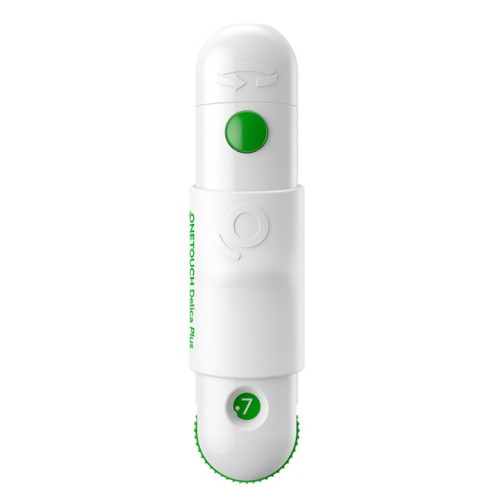
For information on how to use the punched pen, read the relevant instructions for use.
2. Keep the sensor end in contact with the blood drop until the control visor is filled. At that point you will hear an acoustic signal (if enabled) and the display will display a countdown.
3. Read the test results. An acoustic signal will announce the appearance on the screen of the test result with the "Glu" glucose symbol.
4. To remove the sensor, press the expulsion button. The tool will turn off.
Chetonemia test procedure
1. Introduce a new sensor GlucoMen areo Beta-Ketone Sensor (light purple color) in the opening for sensor input. The drop symbol will start flashing on the display and the "Keth" ketone symbol will appear on the bottom left. If nothing appears on the display, remove the sensor, insert it again in the opening and wait for the drop symbol to start flashing.
2. Keep the sensor end in contact with the blood drop until the control visor is filled. You will hear an acoustic signal (if enabled) and the display will display a countdown.
3. Read the test results. An acoustic signal will announce the appearance on the screen of the test result with the "Keth" ketone symbol. The symbol will flash until the instrument is shut down.
4. To remove the sensor, press the expulsion button. The tool will turn off.
Do not use the GlucoMen areo Beta-Ketone Sensor sensors to test samples taken from alternative sites: use only fresh capillary blood taken from the calves.
Warnings
Keep the instrument, sensors and other components away from reach and view of children. Small parts may be a danger of suffocation.
Handle the bottle and sensors with clean and dry hands.
Dispose the bottle and the sensors used in accordance with local regulations.
Handling blood can be dangerous: pay extreme attention by handling blood, sensors, hands and instrument.
Conservation
Storage conditions of the instrument:
- temperature: -20-50°C;
- relative humidity: 20-90%.
Do not store or use the tool in environments where:
- the temperature could fluctuate rapidly;
- moisture is high and causes condensation (bathroom, laundry, kitchen, etc.);
- you are in the presence of a strong electromagnetic field (near a microwave, a cell phone, etc.).
Format
Pack of 1 piece.
Cod. 49195
Medical-diagnostic device in vitro.
System for self-control of blood sugar and ketonemia.
System indicated for the quantitative determination of the concentration of glucose and beta-hydroxybutyrate (beta-cheton) in the whole blood fresh capillary.
Designed for self-control of diabetes mellitus, for the monitoring and control of blood sugar and ketonemia, it can also be used in hospital environment by medical-sanitary personnel.
It is not intended for diagnosis or screening of diabetes and chetonemia, nor for use on infants.
Do not change your therapy on the basis of the result of the tests carried out with the instrument without first consulting your doctor or health care staff.
General characteristics
| Reactive strip | exclusively GlucoMen areo Sensor and GlucoMen areo Beta-Ketone Sensor |
| Measurement of blood sugar | specificity for beta-D-glucose in the blood |
| Enzymatic composition (per cm)2) a reactive strip for measuring blood sugar | - oxidative glucose (from Aspergillus niger), 3.5% - mediator: hexacyanoferrate ion (III), 17,5% - non-reactive substances, 79% |
| Chetonemia measurement | beta-hydroxybutyrate (beta-cheton) in blood |
| Enzymatic composition (per cm)2 of a reactive strip for measuring ketonemia | - D-3-hydroxybutyrate dehydrogenase (Pseudomonas sp.) 1.5% w/w - coenzyme (NAD+), 0.7% w/w - redox mediator: 1,10-fenantrolina-5,6-dione, 20,0% w/w - non-reactive substances: 77.8% w/w |
| Measuring units | |
| Glucose | mg/dL (not editable) |
| Beta-cheton | mmol/L (not editable) |
| Measurement range | |
| Glucose | 20-600 mg/dL |
| Beta-cheton | 0.1-8.0 mmol/L |
| Response time | |
| Glucose | 5 seconds |
| Beta-cheton | 8 seconds |
| Sample volume | |
| Glucose | 0.5 microL |
| Beta-cheton | 0,8 microL |
| Ematocrite Acceptability Range | |
| Glucose | 10-70% (compensated hematocrite) |
| Beta-cheton | 20-60% (compensated hematocrite) |
| Calibration glucose test | the results are equivalent to the concentration of glucose in plasma ( capillary plasma). The GlucoMen areo 2K system is calibrated on the capillary plasma values determined by a Yellow Springs 2300 (YSI) analyzer. The YSI analyzer is calibrated (as a reference secondary measuring procedure) using a series of YSI standards (primary calibrators) acquired directly from the NIST (National Institute of Standards and Technology, USA). |
| Calibration Chetonemia Test | the GlucoMen areo 2K system has been calibrated on the reference values of the plasma determined with a Stanbio Beta-Hydroxybutyrate LiquiColor procedure, Procedures No. 2440 (Stanbio Laboratory, 1261 North Main Street, Boerne, Texas 78006). The analyzer using the Stanbio kit (secondary reference measurement procedure) has been calibrated with a series of standards containing beta-hydroxybutyrate (primary calibrators) prepared with gravimetric method at the Stanbio Laboratory. |
| Igien | automatic expulsion of the reactive strip by dedicated expulsion key |
| Sample | automatic blood sample suction for capillarity |
| BVC | control volume of aspirated blood. The blood is self-absorbed by the sensor and as soon as it reaches the detection electrode, the measurement starts automatically. The reaction does not occur if the blood volume of the sample does not reach the minimum quantity required (if the volume is insufficient the error Er 3) is displayed |
| Use of alternative sites (AST) | allowed (palm of hand and forearm) |
| Memory capacity | 730 glycemic results and 100 results of Beta-cheton with markers, dates and times. When memory is full, the new result will replace the older one |
| External connection | via dedicated cable, NFC or Bluetooth device |
| Output specifications | uSB connection cable available free of charge at 800 869110 Customer Service A. Menarini Diagnostics |
| Battery life | 900 minimum test, or about 1 year (2-3 tests per day) |
| Operating environment | |
| Glucose | temperature: 5-45°C relative humidity: 20%-90% (without condensation) |
| Beta-cheton | temperature: 10-40°C relative humidity: |
| Dimensions | 85.5 mm (L) x 56 mm (P) x 18.2 mm (A) |
| Weight | 46 g (without batteries) |
Mode of use
Glycemia test procedure
1. Introduce a new sensor GlucoMen areo Sensor (white color) in the opening for sensor input. The drop symbol will start flashing on the display and the "Glu" glucose symbol will appear on the bottom left. If nothing appears on the display, remove the sensor, insert it again in the opening and wait for the drop symbol to start flashing.
For information on how to use the punched pen, read the relevant instructions for use.
2. Keep the sensor end in contact with the blood drop until the control visor is filled. At that point you will hear an acoustic signal (if enabled) and the display will display a countdown.
3. Read the test results. An acoustic signal will announce the appearance on the screen of the test result with the "Glu" glucose symbol.
4. To remove the sensor, press the expulsion button. The tool will turn off.
Chetonemia test procedure
1. Introduce a new sensor GlucoMen areo Beta-Ketone Sensor (light purple color) in the opening for sensor input. The drop symbol will start flashing on the display and the "Keth" ketone symbol will appear on the bottom left. If nothing appears on the display, remove the sensor, insert it again in the opening and wait for the drop symbol to start flashing.
2. Keep the sensor end in contact with the blood drop until the control visor is filled. You will hear an acoustic signal (if enabled) and the display will display a countdown.
3. Read the test results. An acoustic signal will announce the appearance on the screen of the test result with the "Keth" ketone symbol. The symbol will flash until the instrument is shut down.
4. To remove the sensor, press the expulsion button. The tool will turn off.
Do not use the GlucoMen areo Beta-Ketone Sensor sensors to test samples taken from alternative sites: use only fresh capillary blood taken from the calves.
Warnings
Keep the instrument, sensors and other components away from reach and view of children. Small parts may be a danger of suffocation.
Handle the bottle and sensors with clean and dry hands.
Dispose the bottle and the sensors used in accordance with local regulations.
Handling blood can be dangerous: pay extreme attention by handling blood, sensors, hands and instrument.
Conservation
Storage conditions of the instrument:
- temperature: -20-50°C;
- relative humidity: 20-90%.
Do not store or use the tool in environments where:
- the temperature could fluctuate rapidly;
- moisture is high and causes condensation (bathroom, laundry, kitchen, etc.);
- you are in the presence of a strong electromagnetic field (near a microwave, a cell phone, etc.).
Format
Pack of 1 piece.
Cod. 49195