Descrizione Clinica
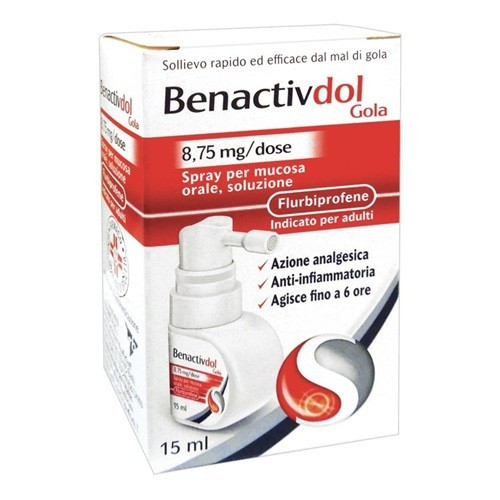
Fluibron Oral Hygiene Spray Gorge 15ml Fluibron
FLUIBRON GOLA 0.25%
active ingredients
FLUIBRON GOLA0,25% Collutory. 100 ml of solution contain: Active ingredient: Flurbiprofen 0.25 g. FLUIBRON GOLA 0.25% oral mucosal spray. 100 ml of solution contain: Active ingredient: Flurbiprofen 0.25 g. Excipients: ethanol: 8,64 g; p-hydroxybenzoate methyl: 0.10 g; p-hydroxybenzoate propile: 0.02 g; hydrogenated castor oil-40 polyxyethylene: 2,00 g; blue coloring license V (E131): 0.0006 g. For the complete list of excipients, see the section 6.1.
Excellent
FLUIBRON GOLA 0.25% Collutory and FLUIBRON GOLA 0.25% Oral Mucosa Spray: Glycerol (98%), ethanol, non crystallized liquid sorbitol, hydrogenated castor oil-40 polyxyethylene, sodium saccharin, methyl parahydroxybenzoate, propile parahydroxybenzoate, mint aroma, blue patent V (E131), citric acid anidro, sodium hydroxide, purified water.
Therapeutic indications
Symptomatic treatment of irritative-inflammatory states also associated with pain of the oropharyngeal cable (e.g. gums, stomatitis, pharyngitis), also as a result of conservative or extractive dentaria therapy.
Contraindications
Hypersensitivity to the active ingredient or any of the excipients. Flurbiprofen is contraindicated in patients with known hypersensitivity (asthma, hives or allergic type) towards flurbiprofen or any of the excipients, and towards aspirin or other NSAIDs. Flurbiprofen is also contraindicated in patients with gastrointestinal hemorrhage history or drilling related to previous treatments with NSAIDs. Flurbiprofen should not be taken by patients with active ulcerative or anamnestic colitis, Crohn's disease, recurrent peptic ulcer or gastrointestinal hemorrhage (defined as two or more distinct episodes of proven ulceration or bleeding). Flurbiprofen is contraindicated in patients with severe heart failure. Third trimester of pregnancy
Population
Undesirable effects can be minimized with the use of the lowest effective dose for the shortest possible duration of treatment needed to control symptoms (see section 4.4). Collutory: the recommended dose is two or three rinses or gargles per day with 10 ml of collutory. It can be diluted in water. Oral Mucosa Spray: the recommended dose is 2 sprays 3 times a day directly addressed to the interested party.
Conservation
None
Warnings
At recommended doses, the possible swallowing of FLUIBRON GOLA 0.25% Collutory and FLUIBRON GOLA 0.25% Oral Mucosa Spray does not involve any harm to the patient as such doses are largely lower than those of the single posology of the product by systemic means. During the first and second trimester of pregnancy, flurbiprofen should not be administered if not in strictly necessary cases. Flurbiprofene administration is not recommended in nursing mothers. The use of FLUIBRON GOLA 0.25% Collutory and FLUIBRON GOLA 0.25% Oral Mucosa Spray, especially if prolonged, can give rise to local sensitization or irritation phenomena; in such cases it is necessary to stop the treatment and consult the doctor to establish, if necessary, suitable therapy. Do not use for protracted treatments. After short periods of treatment without appreciable results consult your doctor. Important information about some excipients: mouthwashing and oral mucosa spray contain para-hydroxybenzoates that can cause allergic reactions (also delayed). The blue coloring license V (E131) can cause allergic reactions. Hydrogenated castor oil-40 polyxyethylene can cause localized skin reactions. Both collutory and spray contain a small amount of ethyl alcohol, less than 100 mg per dose.
Interactions
Interactions with other medicines or other types have not been reported at recommended doses. In any case, please inform your doctor if you take other medications.
Effects
Clinical studies and epidemiological data suggest that taking some NSAIDs (especially if high doses and long-term treatment) may be associated with increased risk of arterial thrombotic events (e.g. myocardial infarction or stroke). During clinical studies carried out with flurbiprofene-based patches, the most commonly reported adverse reactions were local skin reactions (including redness, rash, itching, eruptions, insensitivity and tingling); however, the incidence was low (4.6%). The undesirable effects listed in the table, reported in particular after the administration of formulations for systemic use, are categorized by organic systemic classification and frequency, defined using the following convention: Very common (≥1/10); common (≥1/100 a
Classification for systems and organsReactionFrequencyDiseases of the emolinfopoietic system.Trombocytopenia, aplastic anemia, agranulocytosis:don't notice.Immune disorders.Anaphylactic reaction, hypersensitivity:don't notice.Psychiatric disorders.Depression, confusion, hallucination:don't notice.Nervous system pathologies.Capogiro, cerebrovascular accidents, optic neuritis, migraine, paresthesia, drowsiness:don't notice.Pathologies of the eye.Compromise of vision:don't notice.Ear and labyrinth pathologies.Vertigo, tinnitus:don't notice.Heart disease.Heart failure:don't notice.Vascular disease.Hypertension:don't notice.Respiratory, thoracic and mediastinic pathologies.Asthma, bronchospasm, dispnea (as symptoms of reaction of hypersensitivity):don't notice.Gastrointestinal disease.Nausea, vomiting, diarrhea, flatulence, constipation, dyspepsia, abdominal pain, melena, hematemesis, mouth ulceration, gastrointestinal hemorrhage, aggravated colitis, Crohn's disease aggravated, gastritis, peptic ulcer, gastrointestinal perforation, gastric ulcer with hemorrhargy:don't notice.Pancreatitis:very rare.Pathologies of skin and subcutaneous tissue.Angioedema, skin rash, itching, hives, purple:don't notice.Bollose Dermatitis (including Stevens-Johnson Syndrome, Epidermal Toxic Necrolysis, Multiform Erythema):very rare.Kidney and urinary pathologies.Toxic nephropathy (nephritis tubulointerstitial, nephrosic syndrome:don't notice.Renal insufficiency:rare.Systemic pathologies and conditions for administration.Malessere, fatigue, edema:don't notice.
Reporting of suspicious adverse reactions: The reporting of suspicious adverse reactions that occur after the authorization of the medicinal product is important, as it allows continuous monitoring of the benefit/risk ratio of the medicinal product. Healthcare workers are required to report any suspected adverse reaction via the national reporting system at the address http://www.aifa.gov.it/content/segnalazioni-reazioni-avverse.
Overdosing
Synonyms Overdose symptoms may include nausea, vomiting and gastrointestinal irritation. Treatment The treatment must include gastric lavender and, if necessary, correction of the sierial electrolytic framework. There is no specific antidote for flurbiprofen.
Pregnancy: The inhibition of prostaglandin synthesis can adversely affect pregnancy and/or embryo/fetal development. Results of epidemiological studies suggest an increased risk of abortion and cardiac malformation and gastroschisis after the use of an inhibitor of prostaglandin synthesis in the early stages of pregnancy. The absolute risk of heart failure increased from less than 1% to about 1.5%. It has been considered that the risk increases with dose and duration of therapy. In animals, the administration of prostaglandin synthesis inhibitors showed an increase in pre- and post-system loss and embryo-fetal mortality. In addition, an increase in the incidence of various malformations, including cardiovascular disorders, was reported in animals that had been given prostaglandin synthesis inhibitors during the organogenetic period. During the first and second quarter of pregnancy, flurbiprofen should not be administered if not in strictly necessary cases. If flurbiprofen is used by a woman waiting for conception or during the first and second trimester of pregnancy, the dose and duration of treatment must be kept as low as possible. During the third trimester of pregnancy, all prostaglandin synthesis inhibitors can expose the fetus to: • cardiopulmonary toxicity (with premature closure of arterial duct and pulmonary hypertension); • kidney dysfunction, which can progress in kidney failure with oligo-idroamnios; • the mother and the newborn, at the end of pregnancy, to: • Possible prolongation of bleeding time, an anti-aggregating effect that can occur even at very low doses; • Inhibition of uterine contractions resulting in delay or extension of labor. Therefore flurbiprofen is contraindicated during the third trimester of pregnancy. Nursing: Flurbiprofen is excreted in breast milk; however the excreta quantity is only a small fraction of the maternal dose. Flurbiprofene administration is not recommended in nursing mothers.
Source: Farmadati