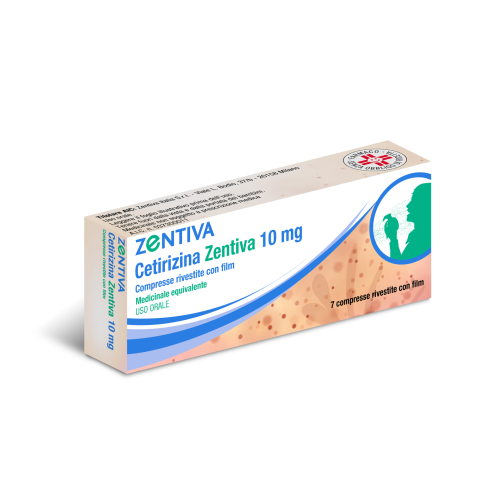
CETIRIZATION SANDOZ 10 MG COMPRESENT RIVES WITH FILM
active ingredients
Each film-coated tablet contains 10 mg of cetirizine dichloride. Excipient with known effect: each tablet coated with film contains 77,71 mg lactose (as monohydrate). For the full list of excipients, see paragraph 6.1
Excellent
Compressed core Cellulose microcrystalline lactose monohydrate magnesium stearate silica colloidal anidra
Coating of the tablet ipromellosa lactose monohydrate macrogol 4000 titanium oxide
Therapeutic indications
Cetirizina Sandoz is indicated in adults and children from 6 years of age: - for the treatment of nasal and eye symptoms of seasonal and perennial allergic rhinitis. - for symptomatic treatment of idiopathic chronic hives.
Contraindications
Hypersensitivity to the active ingredient, hydroxyzine, any derivative of piperazin or any of the excipients listed in the paragraph 6.1. Patients with severe renal impairment with creatinine clearance less than 10 ml/min.
Population
Population Adults and children over 12 years old 10 mg once a day (1 tablet).
Pediatric population The formulation in tablets should not be used in children under 6 years of age as it does not allow the necessary adjustments of the dose.
Children between 6 and 12 years old 5 mg twice a day (half compressed twice a day).
Senior Patients On the basis of the available data, in elderly individuals with normal kidney function no reduction of the dose is necessary.
Renal Compromise There are no data that documents the effectiveness/security ratio in patients with kidney impairment. Since cetirizine is mainly excreted by renal (see paragraph 5.2), in cases where alternative treatments cannot be used, the intervals between doses must be customized according to kidney function. Please refer to the following table and adjust the dose as indicated. To use this posological table, you must have an estimate of creatinine clearance (CL)
C) of the patient expressed in ml/min. The CL
cr (ml/min) can be obtained from the value of sierica creatinine (mg/dl) using the following formula:
| CLcr= | [140 - età (anni)] x weight (kg) | (x 0,85 for women) |
| 72 x sierica creatinine (mg/dl) |
Adult dose adjustment with compromised kidney function
| Group | Creatine clearance (ml/min) | Dose and frequency |
| Normal | >80 | 10 mg once a day |
| Lie | 50-79 | 10 mg once a day |
| Moderate | 30-49 | 5 mg once a day |
| Grave | | 5 mg once every 2 days |
| Renal disease at the last stage - Patients in dialysis | | Contraindicated |
In pediatric patients suffering from renal impairment, the dose should be individually adapted, taking into account kidney clearance, age and body weight of the patient.
Epathetic Comprogation Patients suffering only from liver impairment do not need any dose adjustment. A dose adaptation is recommended for patients with kidney impairment and liver impairment (see kidney damage above).
Method of administration: Tablets should be taken with a glass of liquid.
Conservation
This medicine does not require any special storage temperature. Store in the original packaging to protect the medicine from light.
Warnings
At therapeutic doses, clinically significant interactions with alcohol were not highlighted (for blood levels of 0.5 g/l). However, caution is recommended in case of concomitant alcohol intake. Caution should be used in patients with urinary retention predisposition factors (e.g. spinal cord injury, prostatic hyperplasia), as cetirizine may increase the risk of urinary retention. Caution is recommended in epileptic patients and patients at risk of seizures. The response to skin allergic tests is inhibited by antihistamines and a wash-out period (of 3 days) is required before testing. Itching and/or hives may occur when the treatment with cetirizine is interrupted, even if such symptoms were not present before the start of treatment. In some cases, symptoms can be intense and you may need to start treatment again. Symptoms should resolve when you start treatment again.
Pediatric population The use of the formulation in film-coated tablets is not recommended in children under 6 years of age, since this formulation does not allow proper dose adjustment. It is recommended to use a pediatric formulation of cetirizine. Excipient This medicine contains 77.7 mg of lactose per tablet. Patients with rare hereditary problems of galactose intolerance, total lactase deficiency or glucose-galactose mal absorption should not take this medicine.
Interactions
For the pharmacokinetic, pharmacodynamic and tolerability profile of cetirizine, there are no interactions with this antihistamine. In drug-pharmaceutical interaction studies, in fact, no significant pharmacodynamic interactions or pharmacokinetic interactions have been reported, particularly with pseudophedrine or theophylline (400 mg/die). The degree of absorption of cetirizine is not reduced by food intake; although the absorption rate has decreased. In sensitive patients, the simultaneous intake of cetirizine with alcohol or other substances with depressing action on SNC may cause further decrease in the state of alertness and alteration of performance, although cetirizine does not enhance the effect of alcohol (0,5 g/L of blood levels).
Effects
Clinical studies General Clinical studies have shown that cetirizine at the recommended dose has minor side effects at SNC level, which include drowsiness, fatigue, dizziness and headache. In some cases, SNC paradox stimulation was reported. Although cetirizine is a selective inhibitor of H receptors
1 peripheral and relatively devoid of anti-linergical activity, rare cases of difficulty in urination, ailments of the eye and dryness of the bundles were reported. Anomalous hepatic function has been reported with elevated liver enzymes accompanied by high bilirubin, most of which resolved following discontinuation of treatment with cetirizine dichloride.
List of adverse reactions In the context of double-blind controlled clinical trials, in which cetirizine was compared to placebo or other antihistamines at the recommended dose (10 mg per day for cetirizine), for which there are quantitative safety data, more than 3200 subjects have been treated with cetirizine. Based on this data, the following adverse events were reported in placebo controlled trials with an incidence equal to or greater than 1.0% with cetirizine 10 mg:
| Adverse events (WHO-ART) | Cetirizine 10 mg | Placebo |
| (n = 3260) | (n = 3061) |
| Systemic pathologies and conditions for administration | | |
| Fatigue | 1.63% | 0,95% |
| Diseases of the nervous system | | |
| Heads | 1.0% | 0,98% |
| Cefa | 7,42% | 8.07% |
| Gastrointestinal diseases | | |
| Abdominal pain | 0,98% | 1,08% |
| Dry mouth | 2,09% | 0,82% |
| Nausea | 1,07% | 1.4% |
| Psychiatric disorders | | |
| Sleep | 9,63% | 5,00% |
| Respiratory, chest and mediastinic pathologies | | |
| Pharisees | 1.29% | 1.34% |
Although statistically the incidence of drowsiness with cetirizine was more common than with the placebo, this event resulted from small to moderate entities in most cases. Further studies in which objective tests have been carried out have shown that the usual daily activities are not compromised at the recommended daily dose, in healthy young volunteers.
Pediatric population Adverse reactions with an incidence of 1.0% or more in children aged between 6 months and 12 years, in placebo controlled clinical trials, are:
| Adverse reactions (WHO-ART) | Cetirizine | Placebo |
| (n = 1656) | (n = 1294) |
| Gastrointestinal diseases | | |
| Diarrea | 1.0% | 0,6% |
| Psychiatric disorders | | |
| Sleep | 1.8% | 1.4% |
| Respiratory, chest and mediastinic pathologies | | |
| Rehabilitation | 1.4% | 1.1% |
| Systemic pathologies and conditions for administration | | |
| Fatigue | 1.0% | 0.3% |
Post-marketing experience In addition to adverse reactions found during clinical trials, listed in the previous paragraph, the following side effects were reported during post-marketing experience. Undesirable effects are described in the classification for systems and organs according to MedDRA and in accordance with the estimated frequency based on post-marketing experience. The frequencies are defined as follows: very common (≥ 1/10); common (≥ 1/100, Emolinfopoietic system pathologies
Very rare: trombocytopenia
Immune system disorders Raro: hypersensitivity
Very rare: anaphylactic shock
Disorders of metabolism and nutrition Notable: increased appetite
Psychiatric disorders Not common: agitation
Raro: aggressiveness, confusion, depression, hallucinations, insomnia
Very rare: tick
Notable: suicidal idea, nightmares
Diseases of the nervous system Not common: the week
Raro: convulsions
Very rare: dysgeusia, syncope, tremor, dystonia, dyskinesia
Notable: amnesia, impairment of memory
Eye Disorders Very rare: accomodation disorder, blurred vision, oculorotation
Ear and labyrinth pathologies Notable: vertigo
Heart disease Raro: tachycardia
Gastrointestinal diseases Not common: diarrhea
Hepatobiliary diseases Raro: altered liver function (increasing transaminase, alkaline phosphatease, γ-GT and bilirubin)
Notable: hepatitis
Pathologies of skin and subcutaneous tissue Not common: itching, rash
Raro: hives
Very rare: anjourotic edema, fixed eruption from drugs
Notable: acute generalized exantematic pustolosis
Musculoskeletal pathologies and connective tissue Notable: artralgia
Kidney and urinary pathologies Very rare: disuria, enuresi
Notable: urinary retention
Systemic pathologies and conditions for administration Not common: astenia, malaise
Raro: edema
Diagnostic examinations Raro: weight gain
Description of selected adverse reactions After the interruption of treatment with cetirizine, itching (intense core) and/or hives were reported.
Reporting of suspicious adverse reactions The reporting of suspicious adverse reactions that occur after the authorization of the medicinal product is important, as it allows continuous monitoring of the benefit/risk ratio of the medicinal product. Healthcare workers are required to report any suspected adverse reaction via the national reporting system at the address https://www.aifa.gov.it/content/segnalazioni-reazioni-avverse.
Overdosing
Synonyms Symptoms observed as a result of a cetirizine overdose are mainly associated with effects on the central nervous system or effects that may suggest anti-linergic activity. As a result of taking a dose of at least 5 times the recommended daily dose, the following adverse events were reported: confusion, diarrhea, dizziness, fatigue, headache, malaise, midriasis, itching, restlessness, sedation, drowsiness, astonishment, tachycardia, tremor and urinary retention.
Treatment A specific antidote to cetirizine is not known. In case of overdose, symptomatic or support treatment is recommended. The gastric lavender can be taken into account in the event that a short time has passed since the ingestion of the medicinal product. Cetirizine is not effectively removed for hemodilysis.
Pregnancy
Perspective data collected for cetirizine on pregnancy outcomes do not suggest potential toxicity to the mother or fetus/embry above the basic values. Animal studies show no direct or indirect harmful effects regarding pregnancy, embryo/fetal development, childbirth or post-natal development. Prescription to pregnant women must be done with caution.
Food
Cetirizine is excreted in breast milk at concentrations representing 25% to 90% of those measured in plasma, depending on the sampling time after administration. Therefore, caution should be used when prescribing cetirizine to nursing women.
Fertility
Limited human fertility data are available, but safety issues have not been identified. Animal data shows no safety issues for human reproduction.
Source: Farmadati